Home battery, backup and off-grid: what do you draw?
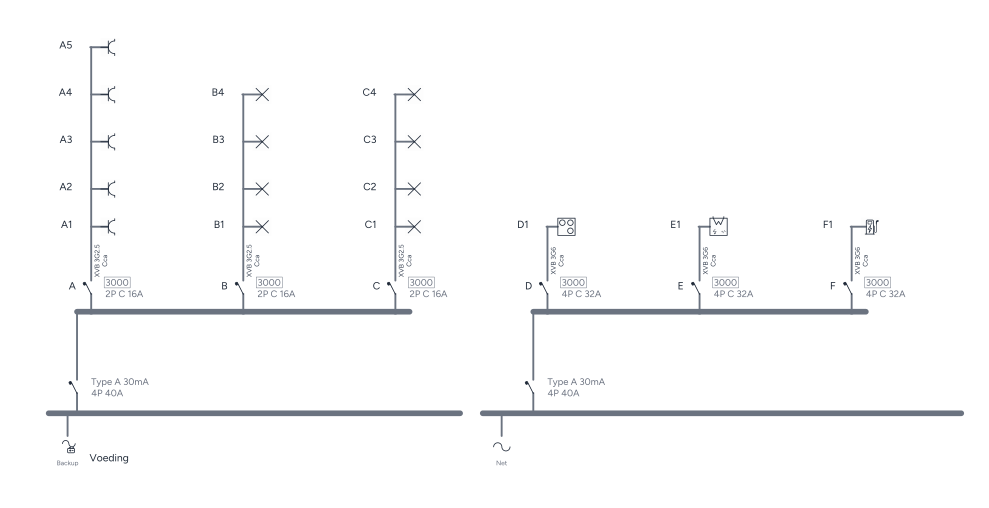
A home battery for self-consumption does not automatically provide emergency power during an outage. The inverter, backup output and transfer arrangement must support that operation. A connection labelled EPS (Emergency Power Supply) or backup therefore needs its own supply path in the diagram.
| Arrangement | What belongs in the one-wire diagram? |
|---|
| Grid-connected home battery | Battery and inverter at the grid supply; no assumed emergency output. |
|---|
| Partial backup | Separate emergency circuit, backup panel or split rails for essential loads. |
|---|
| Whole-home backup | Grid and backup sources with transfer to the load side of the complete installation. |
|---|
| Fully off-grid | Local battery supply and optional solar panels, without parallel operation with the distribution grid. |
|---|
Put only essential loads on backup
Not every home battery needs to power the complete home during a grid outage. The inverter's backup output can supply one protected circuit, a separate backup panel, or a defined part of the main panel. Choose which essential loads remain powered, such as lighting, refrigeration, networking, heating, or one socket. The other circuits remain visibly grid-fed, with a clear split between grid and backup.
One inverter on one phase or three across L1, L2, and L3
A single-phase inverter can supply one selected phase. For a supported coordinated three-phase arrangement, Condui can show three physical single-phase units, such as a possible Victron MultiPlus-II configuration distributed across L1, L2, and L3. Brand, model, and power stay shared while serial numbers and placements can differ per unit.
Whole-home backup or fully off-grid
With whole-home backup, the complete installation sits downstream of the source selection and the load side can change between grid and backup power. Draw a source transfer switch or separate grid and load connections for a hybrid inverter with internal transfer, such as a Deye model that supports this arrangement. A fully off-grid installation instead operates as a local island and never runs in parallel with the distribution grid. Condui keeps these sources and supply paths visibly separate.
The backup demo shows the hybrid-inverter arrangement with two solar-panel strings and no source transfer switch. The off-grid demo shows the more complete arrangement with a DC rail, DC-DC inverters, a source transfer switch, and a Cerbo GX.
ATS, backup box or manual transfer switch?
ATS means automatic transfer switch: automatic changeover between supply sources. A backup box can form part of such a system, but its name alone does not specify how it transfers power. Draw the actual grid input, backup input and output to the loads.
Condui's current modular transfer switch represents manual, mechanically interlocked break-before-make source selection. The first source disconnects before the second connects. It is not an automatic ATS. A supported hybrid inverter with internal transfer can be drawn with separate grid and load connections.
Victron off-grid supplies and hybrid solar inverters
A complete Victron off-grid supply can be drawn as one editable topology, with a Lynx DC bus, battery, DC-DC converters, a modular transfer switch, and a Cerbo GX. This keeps the DC distribution, source selection, and connections to the loads visible together in the same one-wire diagram. Condui can combine this Victron arrangement directly with the rest of the installation, instead of treating the DC supply as a detached image or text.
A suitable hybrid solar inverter, such as a Fronius GEN24 Plus, can also be drawn as part of the supply. Solar panels and the battery connect on the DC side, while the grid connection and separate backup output retain their own place in the one-wire diagram. This keeps the source of each supplied part visible.
The off-grid demo shows the complete Victron arrangement with a Lynx DC bus, DC-DC converters, a modular transfer switch, and a Cerbo GX. The backup demo shows the hybrid inverter with two separate solar-panel strings and no source transfer switch.
The same arrangement in the panel view
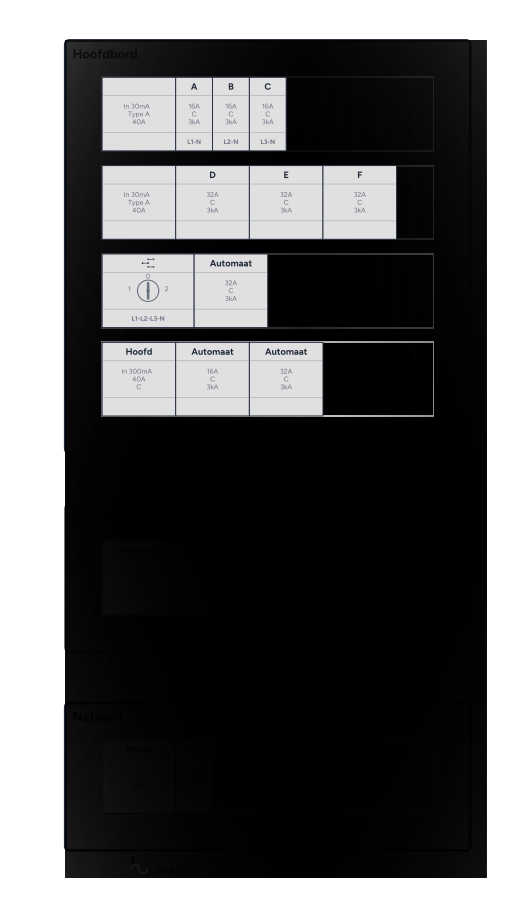
The physical supply components can also be represented in the panel view. Place the source transfer switch, protection, and relevant supply equipment in the main panel, a supply panel, or a separate backup panel, without turning the panel view into a second electrical schematic.
The off-grid demo shows the extended equipment together, including the DC rail, DC-DC inverters, source transfer switch, and Cerbo GX.
From a backup example to your own one-wire diagram
Start with the backup demo for a hybrid inverter or the off-grid demo for an extended DC supply. Then determine which circuits remain grid-fed and which use the backup output. The backup and off-grid drawing guide explains the steps in Condui.
For the Belgian installation context, read the AREI guide to solar panels and home batteries. The diagram describes the real arrangement; equipment, protection and transfer follow the design and manufacturer's documentation.
You can also self-host this drawing environment with Condui Community.
Frequently asked questions
- Can I draw a source transfer switch in the one-wire diagram?
- Yes. Place the source transfer switch in the supply and represent its grid input, backup input, and output to the panel separately.
- Can one Victron MultiPlus-II supply only one socket?
- Yes. Its separate backup output can supply one limited protected emergency circuit, such as a single socket, without drawing the complete main bus as a backup supply.
- Can only part of my distribution panel run from the home battery?
- Yes. Condui can split the main panel into a grid-fed and backup-fed bus section. Essential circuits remain on the backup output while the other circuits are supplied only by the grid.
- Can Condui draw three single-phase inverters as a three-phase group?
- Yes, when the manufacturer supports the units as one coordinated group. Condui can show the three physical units across L1, L2, and L3. Three independent inverters do not automatically form a valid three-phase backup installation.
- Does every home battery provide emergency power during an outage?
- No. Self-consumption storage and supply during a grid outage are different functions. Draw a backup or EPS output only when the chosen inverter and installation actually support it.
- Is a transfer switch the same as an ATS?
- No. ATS means automatic transfer switch. Condui's current modular switch models manual break-before-make source selection. A name or symbol alone does not establish automatic operation.
- Can I put a single phase on backup?
- Yes. Condui tracks the phases per circuit. You can represent a single-phase inverter on a selected phase and follow the associated backup circuits.